 注: 建议图片大小150px*50px

丨
English
注: 建议图片大小150px*50px Views: 0 Author: Site Editor Publish Time: 2026-10-28 Origin: Site


The most frustrating aspects of metal fabrication rarely surface during the design phase. Instead, they hide deep within the manufacturing workflow. Rework, scrapped materials, and missed deadlines represent significant invisible costs that rapidly erode project margins. Fabricating complex assemblies leaves no room for error. The initial cutting stage sets the mechanical precedent. Every single operation that follows depends entirely on this first step.
Inaccurate initial cuts trigger a severe domino effect on the shop floor. If a flat pattern is cut with poor tolerances, downstream processes like forming, robotic welding, and final assembly inevitably require manual intervention. Operators must step in to correct those early discrepancies. This is precisely where modern fabrication technology transitions from a luxury to a critical operational asset.
Recognized as the ultimate solution for achieving pinpoint accuracy, Laser Cutting ensures components are processed correctly the moment the raw material hits the machine bed. By harnessing focused thermal energy driven by advanced computer numerical control, manufacturers completely bypass the physical inconsistencies associated with mechanical shearing or punching. This comprehensive guide explores how precision thermal cutting eliminates secondary processing, lowers overall production costs, and dramatically elevates the structural quality of fabricated metal components.
Zero-Defect Foundation: High-precision laser equipment eradicates the need for manual deburring, grinding, and secondary edge finishing.
Downstream Efficiency: Mathematically accurate initial cuts guarantee flawless transitions into secondary operations. Press brakes and welding fixtures operate without alignment errors.
Cost and Waste Reduction: Microscopic tolerances maximize material utilization through advanced software nesting. This significantly reduces scrap and shrinks the environmental footprint of the facility.
Design Versatility: Modern fiber lasers effortlessly navigate simple structural brackets and highly detailed complex geometries alike, requiring zero physical tooling changes.
Higher ROI: Investing in precision fabrication at the primary stage drastically lowers the hidden labor costs of manual rework. This boosts overall project profitability and accelerates time-to-market.
In the demanding realm of metal fabrication, a tolerance deviation of just a few fractions of a millimeter during the primary cutting stage compromises an entire industrial assembly. Tolerance stack-up is a harsh reality. When flat patterns are cut out of specification, the error compounds sequentially at every subsequent workstation. Imagine a slightly misaligned tab failing to slot into its corresponding groove during a complex weldment. This forces operators to halt automated production lines immediately.
The labor expenditures associated with these manual corrections are substantial. Highly skilled welders and fabricators step away from joining metals to spend valuable production hours grinding, filing, and re-measuring parts just to force a fit. Such manual interventions inflate labor budgets. Furthermore, they introduce human error, potentially compromising the structural integrity and aesthetic finish of the final product.
Scrapping out-of-spec Sheet Metal Parts inflicts direct damage on the bottom line while severely delaying delivery schedules. Consider a practical scenario on a busy shop floor. A traditional mechanical punching machine is tasked with processing a batch of 500 stainless steel brackets. Due to subtle tool wear over the shift, the final 100 brackets exhibit severe edge deformation and dimensional drift. These parts fail quality control. They must be scrapped, re-ordered, and re-processed. The result is wasted raw material, disrupted machine scheduling, and dissatisfied clients.
In contrast, a seamless laser-cut operation operates entirely without physical tool wear. The process relies on light and gas rather than friction and shear. Consequently, the 500th bracket emerges exactly identical to the first. Material yield remains optimal, the production schedule holds firm, and the true cost per part remains predictably low.
Recent manufacturing sector analyses reveal a definitive shift toward automation, extreme precision, and sustainability. Global supply chain pressures and shrinking profit margins are forcing metalworkers to abandon labor-intensive correction methods. The industry standard is rapidly moving toward first-time-right production.
Fabrication facilities adopting high-wattage fiber laser cutting are experiencing up to a thirty percent reduction in downstream rework. This transition is not merely about speed. It is about predictability. Engineers now demand components that transition directly from the cutting bed to the robotic welding cell without a single human touchpoint for deburring. Producing components correctly on the very first attempt effectively reduces the carbon footprint of the entire manufacturing cycle, aligning perfectly with modern sustainable manufacturing initiatives.
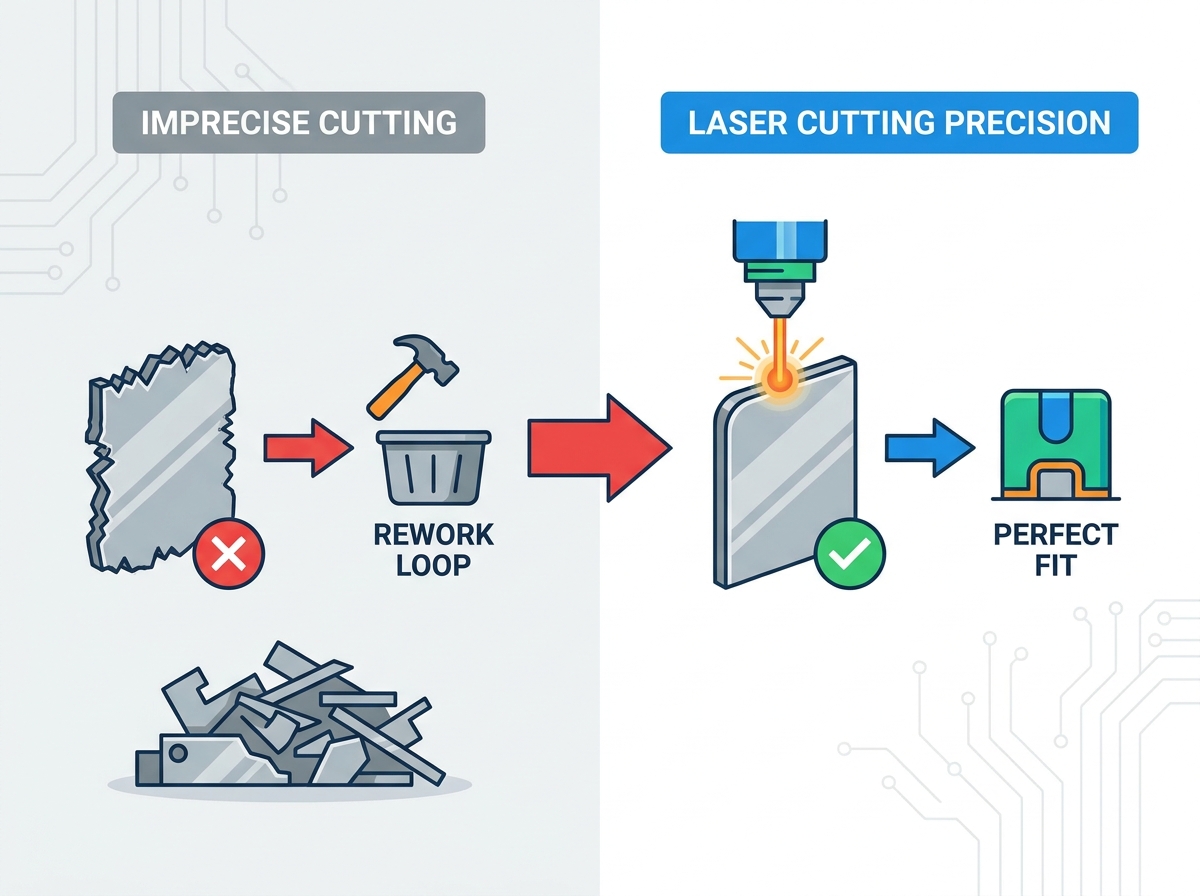
The integration of high-power fiber lasers with automated material handling towers is the primary catalyst for contemporary manufacturing productivity. Unlike legacy systems that rely on gas mixtures and mirrors, modern fiber lasers utilize solid-state diodes and fiber optic cables to amplify the beam. Industrial-grade machines, often operating between 12kW and 20kW, deliver a highly concentrated light source capable of slicing through thick carbon steel or reflective aluminum with unprecedented speed.
The physics underpinning this precision is straightforward yet highly controlled. A tightly focused laser beam rapidly melts or vaporizes the alloy exactly along the programmed vector. Because this energy delivery is incredibly fast and confined to a microscopic focal point, the Heat-Affected Zone is minimized. Keeping this zone small is critical. It prevents the surrounding metal from warping, annealing, or losing its inherent metallurgical properties, ensuring the component remains structurally sound for downstream stress.
In industrial fabrication, accuracy is strictly defined by tolerances. Standard high-end laser systems routinely achieve cutting tolerances of ±0.03 mm. This microscopic level of precision ensures that intricate design features, such as interlocking mortise-and-tenon joints or micro-perforations, are executed flawlessly without binding during assembly.
Equally vital to tight tolerances is repeatability, which is the ability of the machine to return to the exact same coordinate over thousands of cycles. Advanced systems boast repeatability rates of ±0.02 mm. High repeatability guarantees that when mass-producing components, every single piece aligns perfectly with the original digital model. This consistency acts as the foundational prerequisite for automated robotic assembly lines, where even a millimeter of variation triggers mechanical jams.
To truly understand the commercial value of upgrading fabrication methods, one must look at the hard data comparing thermal precision to mechanical force.
| Performance Metric | High-Power Fiber Laser | Traditional Punching / Shearing |
|---|---|---|
| Edge Quality | Dross-free, smooth finish, no secondary deburring | Prone to burrs, micro-fractures, requires grinding |
| Standard Tolerance | ±0.03 mm | ±0.15 mm to ±0.5 mm |
| Tool Wear & Maintenance | Zero physical contact, consistent accuracy | High friction, tools dull over time causing defects |
| Setup Time | Instant digital file upload, zero physical dies | Lengthy physical tool changes and die alignments |
| Rework Rate | Near 0% | 10% to 25% depending on tool condition |
Stripping away secondary processing steps is the most immediate way to slash manufacturing overhead. Here is exactly how precision thermal cutting achieves a streamlined workflow on the shop floor.
Dross-Free and Burr-Free Edges: High-pressure assist gases, such as Nitrogen at 20 bar for stainless steel, are injected coaxially with the beam. This gas physically blows away the molten metal before it can solidify on the bottom edge. The result is a remarkably smooth finish that completely bypasses the deburring station.
No Tool Wear or Physical Distortion: Mechanical stamping applies immense physical force, often causing surface scratching. Thermal cutting is entirely non-contact. No physical stress is applied to the sheet metal, preserving the surface integrity of the material.
Perfect Hole Alignment: Advanced micro-precision allows for the creation of perfectly concentric circular holes. These cutouts are immediately ready for downstream processes like tapping or PEM nut insertion without the need for secondary re-drilling.
Complex Geometry Mastery: The incredibly narrow beam effortlessly navigates intricate component designs. Engineers can design complex organic shapes that traditional punching machines simply cannot handle without prohibitively expensive custom dies.
Minimal Thermal Distortion: Cutting thin-gauge materials with heat traditionally leads to warping. Advanced laser systems utilize rapid pulse control. This allows the material to cool for micro-seconds between cuts, maintaining absolute flatness across the entire sheet.
In the lifecycle of sheet metal fabrication, a bend is only as accurate as the cut that preceded it. Press brakes rely entirely on the exact geometry of the flat pattern to execute a precise angle. If the initial profile is off by even a fraction of a degree, the metal will sit incorrectly against the back-gauges of the machine. The inevitable result is a misaligned bend and a three-dimensional component that fails dimensional inspection.
Perfectly cut edges and highly precise relief cuts provide a flawless foundation for forming operations. When a flat pattern is processed with exact precision, CNC Bending machinery registers the material perfectly every single time.
This synergy between the laser bed and the press brake eliminates the need for operators to manually adjust bend angles or manipulate back-gauge settings to compensate for sloppy cuts. By ensuring the flat pattern is mathematically perfect from the start, manufacturers drastically reduce setup times, eradicate trial-and-error bending, and directly lower scrap rates at the forming station.
Preventing rework begins on the engineer's monitor. Designing for Manufacturability is the proactive practice of optimizing digital drawings specifically for the physical realities of the cutting equipment. By adhering to fundamental design guidelines, engineering teams ensure their parts transition from digital models to physical objects flawlessly.
To maximize efficiency and guarantee a zero-rework workflow, buyers and designers must align on several distinct parameters during the quoting phase.
Kerf Width Compensation: The kerf represents the tiny amount of material burned away by the beam, typically ranging from 0.1 mm to 0.3 mm. While modern software automatically compensates for this, engineers must remain aware of kerf when specifying tight interlocking tabs to ensure a snug fit without manual filing.
Minimum Hole Diameters: A strict rule of thumb in metal fabrication dictates that the diameter of a cut hole should never be smaller than the thickness of the material itself. Attempting to pierce a micro-hole in thick plate causes excessive heat buildup, resulting in a blown-out conical hole that demands secondary drilling.
Spacing and Webbing Limits: Webbing is the solid material left between two parallel cuts. Maintaining an adequate distance between cutouts is vital. If the web is too thin, the concentrated heat will melt the delicate strip, compromising structural integrity and requiring the part to be scrapped.
One of the most compelling financial benefits of this technology is the ability to maximize raw material yield. Advanced software employs sophisticated algorithms to nest various part profiles tightly together on a single sheet of metal. Because the non-contact beam has a narrow kerf and requires no physical clamping space within the cut area, parts can be nested mere millimeters apart. This high-density layout extracts the absolute maximum number of components from every sheet, drastically lowering the material cost per unit.
The Return on Investment of utilizing precision fabrication becomes undeniable when evaluating explicit cost reductions. Capital is preserved by eliminating the need for expensive custom stamping dies. Labor budgets decrease sharply because workers are no longer tethered to deburring wheels or straightening warped parts. Ultimately, zero-defect cutting equates to zero material replacement costs, ensuring projects remain highly profitable.
Possessing state-of-the-art equipment is only half of the manufacturing equation. The true differentiator is human expertise. Achieving a zero-rework environment requires highly skilled engineers and machine operators who deeply understand metallurgical behaviors. Cutting reflective aluminum requires vastly different parameters, such as cutting speed, focal length, nozzle standoff, and assist gas pressure, than processing thick carbon steel. Improper calibration by a novice operator inevitably results in dross and warping, regardless of the machine quality.
To truly streamline supply chains and eliminate the friction of rework, it is highly advantageous to partner with a manufacturer that manages the entire fabrication lifecycle. When a single facility oversees the engineering review, thermal cutting, precision forming, robotic welding, and final assembly, quality control remains unbroken. Communication silos are destroyed.
Ready to eliminate costly rework, lower your production overhead, and streamline your supply chain? Stop paying for hidden inefficiencies. Discover how state-of-the-art equipment paired with an expert engineering team brings your designs to life with unmatched precision. Explore our custom sheet metal fabrication services today and select the right manufacturing capabilities to elevate your next project.
Rework is an insidious profit-killer in the metal fabrication industry. Relying on outdated cutting methods guarantees a cascading series of errors that bloat labor costs, waste raw materials, and jeopardize client relationships. Precision laser technology provides a definitive technological solution to this systemic problem.
By ensuring every flat pattern is cut with microscopic accuracy, manufacturers lay a flawless foundation for all subsequent forming and welding operations. Investing in precision at the initial stage is not just about making a cleaner cut. It is a strategic business decision that guarantees high-quality components, accelerates production timelines, and builds a much stronger bottom line.
Industrial fiber lasers are exceptionally versatile. They excel at processing carbon steel, stainless steel, aluminum, brass, and copper. Skilled machine operators fine-tune the laser power, travel speed, and assist gases for each specific alloy to ensure clean cuts, prevent thermal damage, and completely avoid the need for subsequent rework.
No, not when executed correctly. When the machine is properly calibrated and utilizes the correct assist gases, such as high-pressure Nitrogen for stainless steel, the process produces a pristine edge. The molten material is instantly evacuated from the kerf, leaving a smooth finish that requires no secondary grinding.
Traditional stamping and punching rely on physical mechanical tools that inevitably wear down, become dull, and cause edge defects over time. This leads directly to rework. Laser technology is an entirely non-contact process. Because there is no mechanical friction or tool degradation, the one-thousandth part produced is just as perfect as the first.
Material thickness directly dictates the required laser wattage and cutting speed. When cutting thin gauge metals, the edge quality is nearly flawless with zero dross. As thickness increases, achieving a clean edge requires precise focal point adjustments and optimal oxygen or nitrogen pressure. If parameters are set incorrectly on thick plates, striations and bottom-edge dross occur, which forces manual grinding.
Yes, in many structural applications. Because the initial cut provides tolerances as tight as ±0.03 mm, the fit-up during the welding stage is exceptionally precise. Perfect fit-up minimizes weld gaps and reduces the amount of filler metal required. This limits heat distortion during welding, often eliminating the need to machine the final welded assembly to meet dimensional tolerances.
Precise flat patterns guarantee accurate registration against the back-gauges on a press brake. If the initial cut is mathematically perfect, the subsequent bending process will result in highly accurate three-dimensional parts. This seamless transition eliminates the need for machine operators to make trial-and-error adjustments, saving significant time and reducing scrap metal.


