 注: 建议图片大小150px*50px

丨
English
注: 建议图片大小150px*50px Views: 0 Author: Site Editor Publish Time: 2026-10-19 Origin: Site


Waiting for custom parts delays product launches. In today's fast-paced manufacturing environment, time is undeniably money. Picture this scenario on your shop floor: the engineering team has finalized a groundbreaking design, but the entire assembly line sits idle because a single custom bracket is stuck in a production queue. While modern technology has accelerated many individual processes, overall production turnaround times still vary wildly across the industry. Complex multi-step procedures often cause these frustrating bottlenecks, leaving procurement managers scrambling for answers.
In this guide, we will break down exactly what dictates production schedules. We will demystify the variables controlling your delivery dates and provide actionable engineering strategies to get your parts faster.
Before diving into the technical details, it is crucial to understand the current macro environment. Recent industry analyses indicate a massive shift toward supply chain localization and automated quoting systems. With global logistics remaining unpredictable, many OEMs are moving away from offshore reliance. Instead, they partner with regional fabricators who utilize advanced ERP systems and automated nesting software to shave days off the front-end engineering phase. This trend highlights a fundamental truth: lead time is no longer just about machine cutting speed; it is heavily dictated by digital workflow efficiency and localized material sourcing.
The foundation of any manufacturing schedule begins with the initial CAD model. The intricacy of a digital drawing directly translates to the amount of labor required for machine programming, physical setup, and execution. Procurement managers must understand that every unique feature adds measurable time to the production clock.
Standard tolerances are generally fast to achieve using modern automated machinery. However, when engineers specify exceptionally tight tolerances, the entire manufacturing dynamic shifts. Tighter tolerances demand slower, more deliberate machining feeds and speeds. Operators must perform frequent calibrations and change cutting tools proactively to prevent wear-induced deviations. For example, crafting high-quality Precision Components with a strict +/- 0.005-inch tolerance will inherently take much longer to produce than a part with a standard +/- 0.020-inch allowance. This is due to the meticulous oversight and frequent Coordinate Measuring Machine inspections required at every stage.
Transitioning a flat piece of metal into a three-dimensional object is a complex physical process. Multiple bends, opposing angles, and non-standard radii add massive setup time. While modern CNC Bending is incredibly efficient once the press brake is running, complex geometries necessitate careful offline programming. Technicians must install custom punches and dies, then execute physical test bends to account for material springback. If a design features bends on multiple planes that interfere with standard tooling, operators might need to pause production entirely to reconfigure the machine.
One of the most common bottlenecks occurs before manufacturing even begins. Submitting incomplete data packages forces the manufacturer’s engineering team to reverse-engineer the project. Providing flat 2D PDF drawings without accompanying native 3D STEP files, or submitting designs not optimized for flat-pattern unfolding, creates friction. Resolving design ambiguities and waiting for client approval on revised drawings can paralyze a project for several days.
The physical material chosen for a project dictates not only structural integrity but also delivery speed. Supply chain dynamics play a critical role in production scheduling.
Most established fabrication facilities maintain a robust inventory of standard materials. Common grades of stainless steel, such as 304 and 316, along with aluminum 5052 and standard carbon steel, are usually kept in stock. If your project utilizes these everyday metals, production can commence almost immediately following file approval. In contrast, specifying rare alloys, specific tempers, or unusual surface finishes means the facility must order the material from a third-party mill. This subjects your timeline to external freight transit times and minimum order quantity negotiations.
The gauge of the metal also impacts the timeline. Processing 1/4-inch mild steel is a rapid procedure for a high-wattage fiber laser, whereas cutting 1-inch thick plate requires significantly slower feed rates or a transition to waterjet cutting. Furthermore, bending heavy-gauge steel requires specialized high-tonnage press brakes. Projects requiring thick materials may be placed in a longer queue waiting for this specific heavy-duty equipment.
| Material Category | Common Examples | Typical Stock Status | Impact on Lead Time |
|---|---|---|---|
| Standard Metals | Aluminum 5052, Stainless 304, Mild Steel | High / In-house | Minimal delay. Production starts immediately. |
| Specialized Alloys | Titanium, Copper, Aerospace Aluminum 7075 | Low / Order Required | Moderate to High. Dependent on mill suppliers. |
| Thick Gauge Plate | Greater than 1/2 inch Steel Plates | Moderate | Slight delay due to slower cutting and bending speeds. |
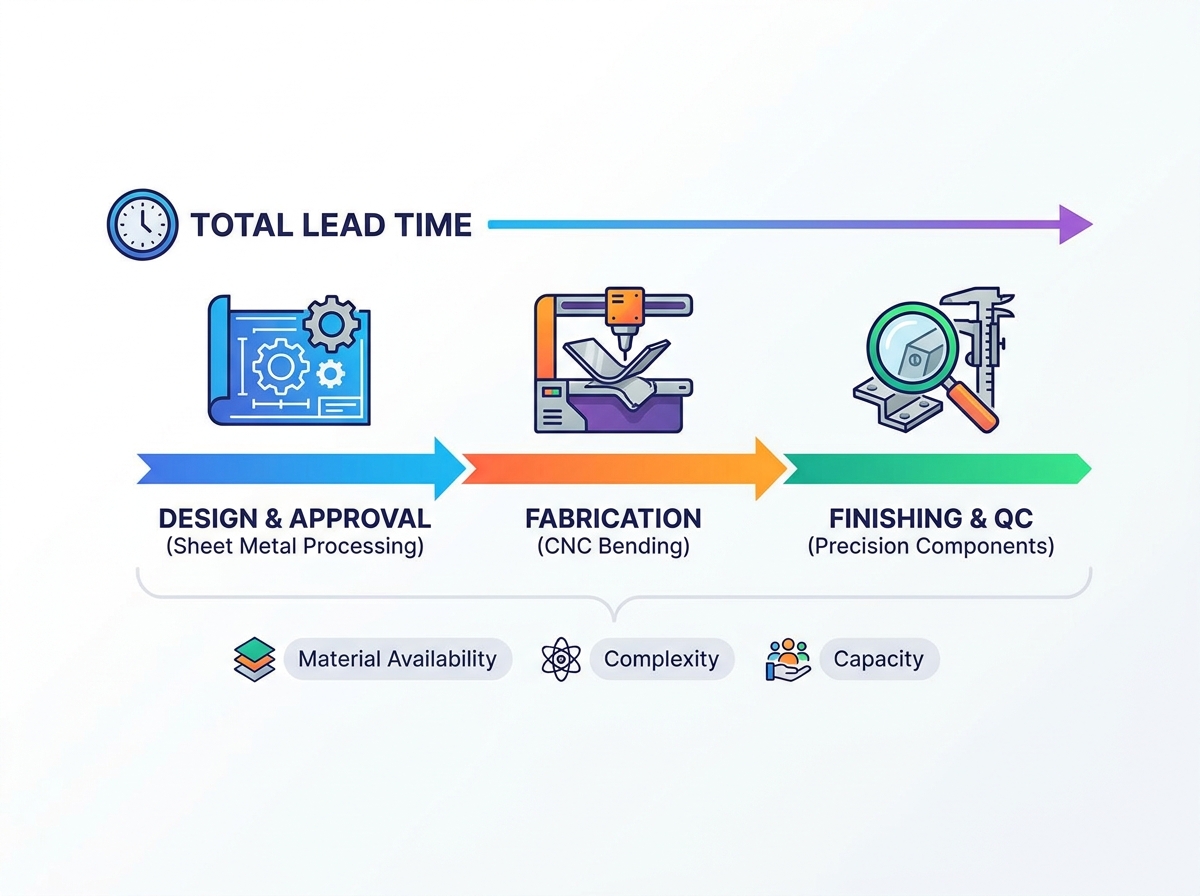
Fabrication is not a single action. It is a sequence of distinct mechanical operations. The more workstations a part must pass through during comprehensive Sheet Metal Processing, the longer the lead time becomes.
The initial stage of transforming raw material into a flat blank is typically the fastest part of the operation. Modern high-wattage fiber lasers can slice through thin-gauge steel at remarkable speeds. CNC turret punches are similarly rapid for parts requiring multiple standard holes or louvers. Generally, if a component only requires 2D flat cutting, the turnaround time is exceptionally brief.
Moving from 2D cutting to 3D forming introduces manual intervention. Even with highly automated machinery, setup time for press brakes adds hours to the schedule. Operators must load the correct tooling, program the backgauges, and run test pieces to verify angles. Consolidating the number of unique bends in a design is a proven way to accelerate this specific phase.
Welding is undeniably the most time-intensive stage of structural fabrication. Whether utilizing TIG or MIG welding, the process is often highly manual. Complex assemblies require engineers to design and build custom fixtures just to hold the components securely before the first weld can even be struck. In addition, post-weld grinding and polishing to achieve a seamless cosmetic finish require skilled manual labor, which significantly extends the production calendar.
The final steps of fabrication are notorious for causing unexpected bottlenecks. A raw metal part is rarely the final product. It typically requires surface treatments for corrosion resistance, electrical insulation, or cosmetic appeal.
Different finishes require vastly different preparatory and application times. Simple deburring can be done quickly. However, powder coating requires parts to be chemically washed, dried, electrostatically sprayed, and baked in an oven. Anodizing involves submerging parts in chemical baths for precise durations. Each of these steps adds mandatory processing time that cannot be rushed without compromising the final quality.
The location of the finishing process is a major determinant of lead time. Manufacturers who possess in-house powder coating lines can move parts from welding directly to finishing in minutes. In contrast, outsourcing to a third-party vendor expands the timeline dramatically. This requires packing the parts, arranging freight transport, waiting in the secondary vendor’s production queue, and transporting the finished goods back for final inspection.
The quantity of parts ordered fundamentally alters how a manufacturing facility schedules the job and allocates its resources.
For prototype runs, such as one to ten parts, the actual machine run-time is negligible. The dominant factor in the lead time is the setup. Programming a laser cutter and setting up a press brake takes the exact same amount of time whether the operator is making five parts or five thousand. Therefore, the setup-to-production ratio is heavily skewed. For high-volume production, the setup time is amortized across thousands of units. However, the sheer physical volume means the machines will be occupied for days. To mitigate long waits for large orders, procurement teams can negotiate staggered deliveries, receiving partial batch shipments to keep assembly lines moving.
Even the most simplistic project will face delays if the selected fabrication shop is operating at maximum capacity. A manufacturer with scalable capacity and redundant machines is much better equipped to absorb new orders. Furthermore, ensuring dimensional accuracy takes time. First Article Inspection requires a quality engineer to meticulously measure the first produced part against the CAD model. Only after this rigorous inspection is passed can the rest of the batch be produced.
Procurement managers and design engineers consistently face the challenge of accelerating project timelines without compromising quality. Reducing lead time is rarely about forcing machines to run faster. Instead, it is about eliminating friction, reducing setup variables, and optimizing the design for the shop floor.
The most empirically proven method for reducing fabrication time is implementing Design for Manufacturability principles. When parts are engineered with the specific physical limitations of modern fabrication equipment in mind, manufacturers spend less time troubleshooting.
Specifically, standardize your bend radii. Every unique bend radius in a design requires a specific set of physical tools to be loaded into the press brake. By standardizing all bend radii to a single dimension across the entire part, the operator can execute all forming steps in a single, continuous sequence without stopping to swap heavy tooling.
Material procurement introduces a massive variable into the project timeline. To mitigate supply chain risks, consult with your manufacturing partners during the prototype phase to identify which material gauges are consistently stocked. If a design calls for a 0.090-inch thickness but the shop carries an abundance of 0.080-inch aluminum that meets structural requirements, adjusting the design to match available inventory will instantly remove procurement delays.
Logistics and vendor handoffs consume valuable time. If a project requires laser cutting at one facility, forming at another, and powder coating at a third, transit times compound rapidly. Partnering with a single, vertically integrated facility is a highly strategic decision. When a manufacturer manages the entire lifecycle of the product under one roof, they maintain complete control over the production schedule, eliminating logistical delays.
Lead times in custom sheet metal fabrication are rarely arbitrary. They are the direct result of a complex balancing act dictated by design intricacy, material availability, the number of mechanical processing steps, and the operational capacity of the manufacturing facility.
While it is impossible to bypass the physical constraints of machining, proactive planning makes a significant difference. By applying smart design principles, standardizing material choices, and selecting a comprehensive manufacturing partner, businesses can effectively shave weeks off their production schedules.
Ready to streamline your next project? Explore the professional capabilities and integrated solutions at DNC CNC Sheet Metal to find the right services that match your exact engineering requirements and keep your supply chain moving efficiently.
The industry average lead time for custom fabrication typically ranges from two to four weeks. This depends heavily on the complexity of the design, the required volume, and the extent of secondary finishing operations. Simple flat-cut parts without bending or coating can often be turned around in a matter of days. Conversely, complex assemblies requiring multiple forming stages, certified welding, and custom powder coating will naturally push the timeline toward the four-week mark.
The physical act of bending the metal is remarkably fast, often taking only seconds per bend. The true time cost lies in the setup, tooling changeovers, and machine programming. Modern press brakes require careful calibration to account for material springback and precise bend deductions. By minimizing the number of unique bend angles and standardizing bend radii within your CAD models, you can drastically reduce the setup time.
Yes, the majority of professional fabrication facilities offer expedited manufacturing services for a premium fee. Expediting is only physically possible under specific conditions. The required raw materials must be currently in stock. The submitted engineering files must be flawless and ready for immediate flat-pattern generation. Expediting is generally more feasible for parts that do not require outsourced secondary processes.
Surface finishing is consistently one of the most time-intensive phases of fabrication. Finishes require extensive preliminary preparation, including chemical washing, degreasing, and mechanical deburring to ensure proper adhesion. If a fabrication shop does not possess in-house finishing capabilities, they must physically package and transport the components to a specialized vendor, which introduces transit time and secondary scheduling queues.
Tolerances dictate the margin of error permitted during manufacturing. When engineers specify exceptionally tight tolerances, operators must run cutting lasers at slower speeds to minimize thermal distortion. They must perform frequent test bends and utilize highly calibrated coordinate measuring machines for rigorous quality inspections. By reserving tight tolerances strictly for critical mating surfaces, production speed can be significantly optimized.
To prevent delays during the initial engineering review, it is best practice to submit both 3D models and 2D drawings. The preferred 3D formats are STEP or IGES, as these are universally accepted by modern CAM software for accurate flat-pattern generation. Alongside the 3D model, you must provide a 2D PDF drawing detailing critical dimensions, tolerance requirements, material specifications, and finishing instructions.
Material thickness directly correlates with the cutting feed rate of a laser machine. Thin-gauge metals, such as 18-gauge steel, can be processed at extremely high speeds using modern fiber lasers, keeping cycle times short. As the material thickness increases, the laser must move significantly slower to ensure a clean cut without excessive dross. For extremely thick plates, the facility may need to route the job to a slower waterjet or plasma cutter, which extends the overall processing time.
Cycle time refers to the actual physical time it takes for a machine to complete a specific operation on a single part, such as a laser cutting a profile in thirty seconds. Lead time encompasses the entire project duration from the moment a purchase order is received to the final delivery. Lead time includes engineering review, material procurement, machine setup, cycle time, finishing operations, quality inspection, and shipping logistics.


