 注: 建议图片大小150px*50px

丨
English
注: 建议图片大小150px*50px Views: 0 Author: Site Editor Publish Time: 2026-08-06 Origin: Site


A poorly constructed Request for Quote (RFQ) creates immediate friction across operations. Missing technical specifications or unclear commercial terms inevitably lead to inaccurate quotes, extended lead times, and substandard parts arriving at the dock. When engineering design intent fails to translate clearly to procurement execution, the entire manufacturing timeline suffers. Standardizing complex technical requirements allows multiple vendors to provide accurate, apples-to-apples quotes for custom CNC machining. Without a structured RFQ, procurement teams struggle to filter unqualified vendors or protect sensitive intellectual property. A comprehensive RFQ framework serves as the primary mechanism to secure scalable production agreements and ensure parts meet exact specifications upon delivery. It bridges the gap between shop floor realities and purchasing objectives, ensuring that every dimension, material grade, and finishing requirement is documented and understood before a single chip is cut.
A comprehensive RFQ requires both 3D CAD models for geometry and 2D technical drawings for critical tolerances, surface finishes, and threading.
Clearly defining CNC machining supplier requirements—such as ISO certifications, ITAR registration, and specific inspection protocols—eliminates unqualified shops early in the sourcing process.
Over-tolerancing is the leading cause of inflated quotes; strategic tolerance assignment balances part functionality with manufacturing costs.
Evaluating quotes requires analyzing the breakdown of setup costs, material costs, and machining time, rather than just the final unit price.
Proper material specification must include exact grades, temper states, and required compliance certifications (e.g., DFARS, RoHS).
Vague RFQs generate immediate problems on the shop floor and in the purchasing department. Machine shops often respond to ambiguous requests with "no-bids," wide pricing variances, or hidden post-order engineering charges. When a supplier has to guess the intended tolerance, surface finish, or thread class, they usually pad the quote to cover potential risks. If a drawing simply calls out "aluminum" without specifying the grade or temper, the shop might quote 6061-O instead of the required 6061-T6, leading to parts that fail under load. This ambiguity wastes time, inflates production budgets unnecessarily, and causes severe delays during assembly.
A standardized RFQ bridges the gap between engineering and procurement. It aligns technical specifications, such as material grades and geometric tolerances, with commercial requirements, including batch sizes and delivery schedules. This alignment ensures that the engineering team gets the exact part they designed while procurement secures reliable delivery terms. When you send a complete package, the machinist knows exactly what tools to pull, what workholding to design, and how much time to allocate for inspection.
A successful RFQ response provides a transparent cost breakdown, confirmed lead times, and documented Design for Manufacturability (DFM) feedback. When a supplier returns a quote that clearly delineates setup time, material costs, and machining hours, procurement teams can make informed, data-driven sourcing decisions. You want to see exactly how much you are paying for the raw stock versus the time the spindle is actually turning.
| RFQ Element | Poor Execution | Successful Execution |
|---|---|---|
| Material Specification | "Stainless Steel" | "316L Stainless Steel, ASTM A276, Annealed" |
| Tolerances | Blanket +/- 0.001" on all dimensions | ISO 2768-m for general, +/- 0.0005" only on bearing bores |
| Quantities | "Quote 1000 parts" | "Quote 50 prototypes, 500 first run, 2000 annual volume" |
| Drawings | Only a 3D STEP file provided | 3D STEP file + 2D PDF with tapped hole callouts and GD&T |
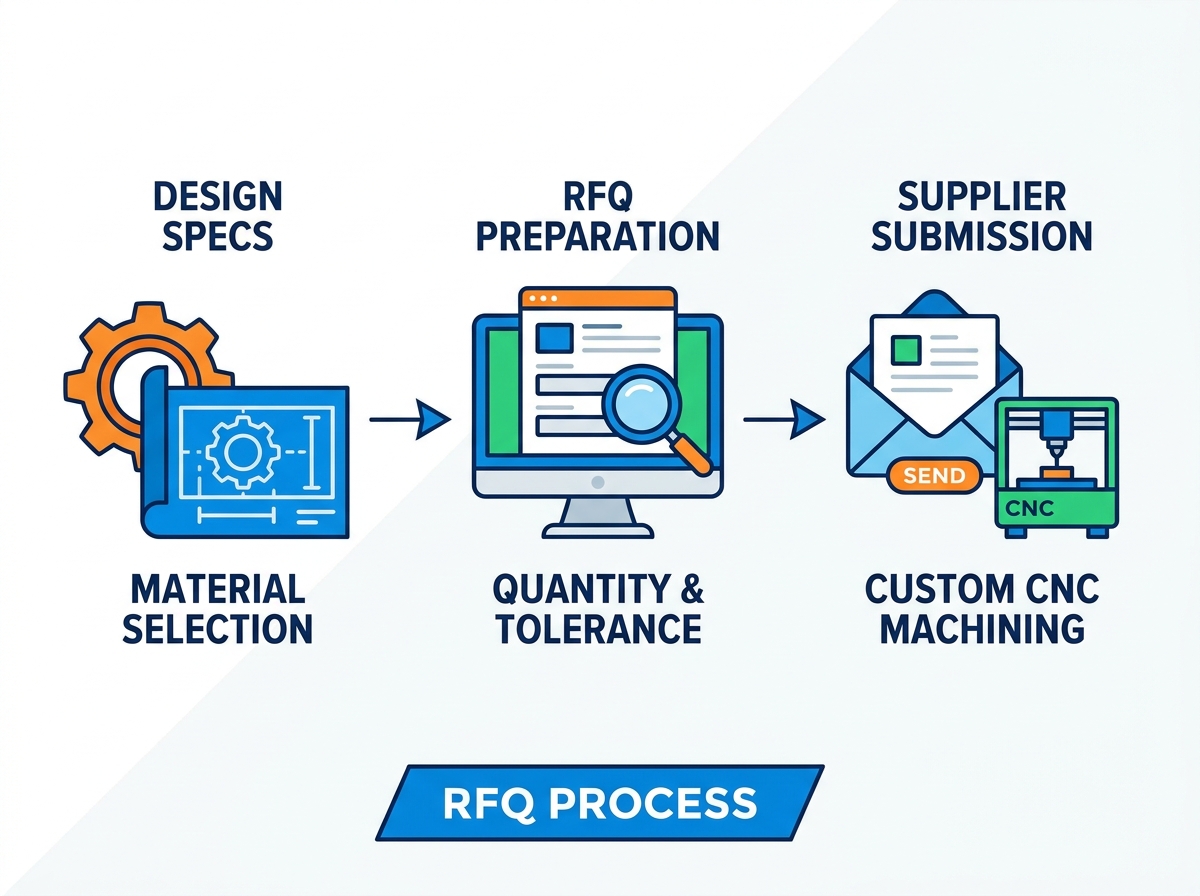
Both 3D models and 2D drawings play distinct, non-interchangeable roles in the quoting and manufacturing process. 3D models, typically in STEP, IGES, or Parasolid formats, drive the Computer-Aided Manufacturing (CAM) programming. They provide the exact geometry needed to generate toolpaths, calculate material removal rates, and design custom soft jaws for workholding. However, 3D models rarely convey manufacturing intent. A CAM programmer cannot look at a STEP file and know which surface mates with a bearing and which surface is just cosmetic.
2D drawings, usually submitted as PDFs, serve as the legal contract for the part. They dictate critical tolerances, surface finishes, tapped holes, and specific inspection criteria. If a hole needs to be reamed to a precise diameter rather than just drilled, that information lives on the 2D drawing. For sheet metal or flat custom machined components, vector files like DXF or DWG are necessary to program laser cutters and waterjets accurately. Always ensure the revision level on the 2D drawing matches the 3D model exactly.
Exact material callouts prevent catastrophic part failures. Requesting "Aluminum" is insufficient; you must specify Aluminum 6061-T6, 7075-T6, or MIC-6 cast tooling plate depending on the application. Similarly, distinguish between 304 and 316L Stainless Steel. The temper state directly affects the material's machinability, chip formation, and final mechanical properties. Machining annealed copper requires completely different feeds, speeds, and tooling geometries compared to machining hardened tool steel.
In some cases, allowing material alternatives reduces costs or improves availability. If a specific grade is out of stock, a competent shop might suggest a functional equivalent. Always specify compliance and traceability requirements upfront. This includes Mill Test Reports (MTRs), Certificates of Conformance (CoC), DFARS compliance, and RoHS/REACH standards. If you need full material traceability back to the melt source, state this clearly in the RFQ, as it requires the shop to quarantine and track the raw stock throughout the entire production run.
Specify standard ISO 2768 (medium or fine) for general dimensions. Reserve tight geometric tolerances (GD&T) only for critical mating surfaces. Document all secondary operations clearly. State whether the part requires anodizing, passivation, heat treating, or powder coating, and clarify if the primary machine shop must manage these subcontractors. Managing outside processing adds lead time and markup, but it simplifies your supply chain.
Surface roughness requirements need standard metrics. Use specific callouts like Ra 3.2 µm for standard machining, Ra 1.6 µm for smooth finishes, or Ra 0.8 µm for precision sealing surfaces. Vague terms like "smooth" lead to rejected parts. If a specific tool mark direction (lay) is required for an O-ring seal, indicate that on the drawing.
Structure volume tiers to evaluate a supplier's scalability. Requesting quotes for prototype (1-5 parts), low-volume (50-100 parts), and high-volume (1000+ parts) quantities shows how the shop amortizes setup costs. A shop might run a prototype on a standard 3-axis mill, but move a 1000-part order to a horizontal machining center with a pallet pool to reduce cycle times. Distinguish between a one-time purchase order and a blanket order with scheduled releases. Kanban or Just-In-Time (JIT) agreements require different capacity planning and raw material stocking strategies from the supplier.
Define special handling for cosmetic parts. Specify individual pocket packaging, egg-crate dividers, or foam wrapping to prevent scratches during transit. Parts banging together in a bulk box will ruin a pristine anodized finish. For carbon steels and raw metals, specify rust-prevention requirements such as light oil coating or the use of Volatile Corrosion Inhibitor (VCI) bags. If parts are shipping overseas, specify heavy-duty export crating to withstand rough handling and humidity.
Mandate specific certifications based on your industry. General manufacturing typically requires ISO 9001. Aerospace applications demand AS9100 certification, which includes strict requirements for risk management and counterfeit parts prevention. Medical device components require ISO 13485, while automotive parts fall under IATF 16949. Verifying these CNC machining supplier requirements early filters out shops lacking the necessary quality infrastructure to support your production needs.
Request a detailed machine list to verify physical capabilities. You need to know if the shop has the right iron on the floor. Distinguish between standard 3-axis milling, complex 5-axis milling for continuous contouring, Swiss turning for small cylindrical parts, and multi-tasking mill-turns that can drop a part complete in one operation. Knowing the supplier's equipment ensures they can handle the specific geometry and volume of your project without excessive manual setups.
3-Axis Mills: Ideal for flat, prismatic parts requiring operations on a single plane.
5-Axis Machining Centers: Necessary for complex geometries, impellers, or parts requiring multiple setups consolidated into one.
Swiss-Style Lathes: Required for high-volume, small-diameter turned parts with tight concentricity requirements.
Horizontal Machining Centers (HMC): Best for high-volume production runs due to pallet changers and excellent chip evacuation.
Outline all requirements for quality documentation. This includes First Article Inspection (FAI) reports, often in the AS9102 format, Coordinate Measuring Machine (CMM) data, and non-destructive testing (NDT) results. Specify the required Inspection Level, whether that involves standard AQL sampling plans or 100% inspection of critical dimensions. If you require a CMM report for every part, the shop needs to factor that inspection time into their quoted cycle time.
Aerospace components require complete material traceability back to the melt source. RFQs must specify ITAR registration if handling defense articles. Strict adherence to FAR/DFARS compliance and AS9100 standards is non-negotiable for these CNC machining applications. You must also specify requirements for foreign object debris (FOD) prevention during manufacturing and packaging.
Medical manufacturing demands biocompatible material handling and lot traceability. Machining surgical grade stainless steel or PEEK requires specific coolants that will not contaminate the final product. RFQs should highlight the need for cleanroom packaging, ultrasonic cleaning, and strict ISO 13485 compliance to ensure parts meet regulatory standards.
Automotive RFQs prioritize high-volume scalability and PPAP (Production Part Approval Process) levels 1 through 5. Focus on cost-per-part reduction strategies, cycle time optimization, and long-term contract stability to support continuous assembly lines. Suppliers must demonstrate robust statistical process control (SPC) capabilities.
Semiconductor components require critical cleanliness standards and tight geometric tolerances for RF shielding. Specify ESD-safe packaging and high-purity material requirements, such as oxygen-free copper or specialized aluminum alloys. Surface finishes must often be pristine to prevent outgassing in vacuum environments.
Deconstruct every quote into specific categories. Look for non-recurring engineering (NRE) fees, setup and programming fees, raw material costs, machining cycle times, and secondary finishing costs. A lump-sum quote hides inefficiencies and makes apples-to-apples comparisons impossible. If one shop quotes $500 for setup and $10 per part, and another quotes $100 for setup and $20 per part, you need to calculate the break-even point based on your expected order volumes.
Examine the trade-offs between expedited delivery and premium rates. Offshore suppliers might offer lower unit costs but require extended shipping times, customs clearance, and higher logistical risks. Domestic suppliers often provide faster turnarounds, easier communication, and lower minimum order quantities, which mitigates the risk of supply chain disruptions.
A supplier providing proactive DFM suggestions presents high long-term value. If a shop identifies deep internal pockets that require custom extended-reach tooling, hard-to-machine radiuses that need EDM work, or unnecessary tight tolerances, they demonstrate technical competence. This feedback reduces scrap rates, shortens cycle times, and lowers production costs over the product lifecycle.
Establish clear parameters for payment terms, such as Net 30 or tooling deposits. Define lead-time penalties for late deliveries. Clearly state the ownership of custom fixtures, molds, or specialized tooling paid for during the NRE phase. If you pay for a custom tombstone fixture, you need to know if you can pull that fixture and move it to another supplier if the relationship sours.
Applying tight tolerances to non-critical dimensions exponentially drives up scrap rates, cycle times, and inspection costs. Evaluate every dimension on the drawing. If a standard ISO 2768 tolerance works for a clearance hole, do not apply a +/- 0.001" tolerance. Tight tolerances force the machinist to take spring passes, change inserts more frequently, and spend more time at the CMM, all of which you pay for.
Missing thread callouts, undefined edge breaks, or conflicting information between 2D drawings and 3D CAD files halt production. If the 3D model shows a 0.250" hole but the 2D drawing calls out a 1/4-20 tapped hole, the shop has to stop and ask for clarification. Suppliers will pause machining to submit Requests for Information (RFIs), delaying your lead time and frustrating the shop floor.
Execute a mutual Non-Disclosure Agreement (NDA) prior to sharing proprietary CAD files. Verify the supplier's digital data security protocols to ensure your designs remain confidential and protected from unauthorized distribution. Ensure they have secure file transfer protocols (SFTP) rather than just emailing unencrypted STEP files.
Failing to specify thread classes (e.g., Class 2B vs. 3B) or pitch leads to assembly failures. A standard coarse thread will not mate with a fine-pitch bolt. Document all threading requirements clearly on the 2D drawing, including whether the thread needs to be cut, rolled, or form-tapped, and specify the required thread depth versus the drill depth.
Execute a mutual Non-Disclosure Agreement (NDA) before transmitting any proprietary CAD files or technical drawings to prospective vendors.
Request a pilot run or prototype batch to validate the supplier's machining capabilities, surface finish quality, and dimensional accuracy.
Conduct a virtual or physical facility audit to verify equipment lists, maintenance schedules, and quality management system certifications.
Initiate the First Article Inspection (FAI) process to establish a strict baseline for full-scale production quality and metrology standards.
A: A complete RFQ must include 3D CAD files for toolpath generation, detailed 2D drawings for tolerances and threads, exact material grades and tempers, required quantities, delivery schedules, surface finish callouts, and necessary quality certifications.
A: Tighter tolerances exponentially increase costs. They require specialized cutting tools, slower machining feed rates, rigorous metrology equipment, and frequent tool changes, which collectively increase cycle times and potential scrap rates.
A: 3D models are imported into CAM software to generate the physical machining toolpaths. 2D drawings serve as the technical and legal contract, dictating critical tolerances, thread classes, surface roughness, and specific inspection criteria that cannot be read from a basic 3D model.
A: An FAI verifies that the supplier's production process reliably produces parts meeting all engineering specifications. It involves a comprehensive measurement of a sample part from the first production run before authorizing full-scale manufacturing.
A: Temper states dictate the mechanical properties and machinability of the metal. For example, Aluminum 6061-O is soft and gummy to machine, while 6061-T6 is heat-treated for strength, yielding better chip formation and surface finishes.


