 注: 建议图片大小150px*50px

丨
English
注: 建议图片大小150px*50px Views: 0 Author: Site Editor Publish Time: 2026-09-03 Origin: Site


Procuring structural components is a high-stakes endeavor. I have seen it happen firsthand: a single weak weld in a load-bearing frame doesn't just halt an assembly line. It can trigger catastrophic field failures, massive product recalls, and severe liability claims. As companies transition from a successful prototype to full-scale bulk production, procurement managers frequently hit unexpected and costly hurdles. Inconsistent quality, hidden rework fees, and delayed timelines are common pitfalls.
To navigate this complex landscape safely, you must thoroughly vet your manufacturing partners. You need to understand their stringent quality control standards and establish bulletproof pre-production protocols long before issuing that final purchase order.
Verify Certifications: Always ensure your manufacturer complies with strict structural welding codes, such as AWS D1.1 or ISO 3834.
Prioritize DFM (Design for Manufacturability): Optimizing your component design before bulk production saves significant time and reduces material waste.
Leverage Automation: For large-volume orders, automated welding guarantees dimensional consistency and lowers long-term manufacturing costs.
Demand Strict QC: Non-Destructive Testing (NDT) and First Article Inspections (FAI) are non-negotiable for load-bearing structures.
Evaluate Supplier Capacity: Choose a manufacturing partner with proven scalability, transparent communication, and robust supply chain management.
Sourcing load-bearing assemblies is fundamentally different from buying cosmetic sheet metal enclosures. Structural components form the backbone of heavy machinery, commercial vehicles, and architectural frameworks. The stakes are considerably higher. Consequently, engineering teams and buyers must apply rigorous scrutiny to every phase of the manufacturing process.
Recent industry analyses highlight a pivotal shift in B2B procurement strategies. We are seeing a massive move away from simply chasing the lowest offshore bid. Instead, modern supply chain managers prioritize fabricators offering ironclad material traceability and resilient local capacities to mitigate global shipping disruptions. Furthermore, the rising demand for high-strength, lightweight materials—such as High-Strength Low-Alloy (HSLA) steel—requires significantly tighter processing controls.
When dealing with structural steel, knowing the exact origin and chemical composition of your raw materials is non-negotiable. You must mandate material traceability through Mill Test Reports (MTRs). An MTR is a certified document from the steel mill verifying physical properties like yield and tensile strength. Without proper traceability, bulk production runs carry an unacceptable level of risk.
Unlike standard metal brackets, structural components endure dynamic stress, environmental fatigue, and heavy payloads continuously. Welding parameters must be carefully calibrated to ensure deep penetration without compromising the base metal's metallurgical integrity. Specifically, the Heat-Affected Zone (HAZ) must be managed to prevent brittleness. This ensures the component can withstand cyclic loading over its intended lifespan.
Scaling from a single successful prototype to a run of thousands demands a systematic approach. Before authorizing a bulk production run for custom welded parts, implement strict pre-production validation protocols to avoid downstream disasters.
Does your prototype function flawlessly? Great. But what if its intricate joint design makes torch access nearly impossible on the assembly line? If a comprehensive DFM review misses this, manual labor and rework will destroy your profit margins. During this phase, experienced engineers analyze CAD files to spot manufacturing bottlenecks early.
The primary goal is to eliminate unnecessary welds and suggest self-locating joint designs, like tab-and-slot configurations. By reducing total weld volume and simplifying assembly, a competent fabricator can significantly reduce thermal distortion and cut labor times, all while maintaining structural integrity.
Never proceed to mass manufacturing without a First Article Inspection (FAI). This is a formal process where a pilot part is produced using the exact methods, materials, and equipment intended for the mass run. Demand a comprehensive FAI report verifying all dimensional tolerances (often requiring ±0.1mm precision for critical mating surfaces), weld penetration depths, and aesthetic finishes. Ultimately, this pilot run acts as your final fail-safe.
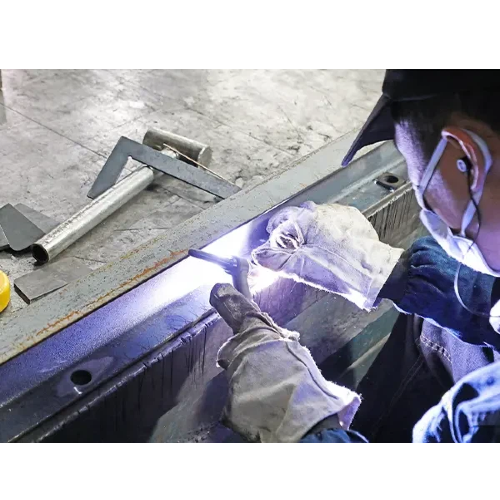
As production volumes scale, relying solely on manual labor introduces variables you simply cannot afford. For bulk orders, automation is no longer a luxury. It is a fundamental requirement for cost control and risk mitigation.
Human operators, no matter how skilled, experience physical fatigue. Over a production run of 5,000 units, manual variations in travel speed, torch angle, and heat input inevitably lead to inconsistent weld profiles and dimensional warping. In contrast, robotic welding eliminates these variables completely. Equipped with multi-axis arms and precise wire-feed parameters, automated cells ensure that the ten-thousandth part is identical to the first. This repeatability is vital for structural components that must align perfectly within larger assemblies.
While the initial setup of robotic cells requires investment, the long-term benefits for bulk buyers are undeniable. Automation drastically reduces cycle times. Robots weld faster and operate continuously. In addition, the precision of automated systems minimizes spatter, virtually eliminating the need for post-weld grinding. By lowering labor costs and increasing throughput, manufacturers can offer highly competitive per-unit pricing.
Assuming visual perfection equals structural integrity is a dangerous oversight in load-bearing applications. Procurement managers must require their fabrication partners to implement a rigorous, documented Quality Assurance (QA) framework. When sourcing structural steel fabrication, understanding the specific inspection standards applied to your components is critical.
Quality control divides into destructive testing (breaking a sample part) and Non-Destructive Testing (NDT). For bulk runs of high-value structural components, NDT is the industry standard. It allows inspectors to evaluate internal integrity without damaging the final product.
Here is a core breakdown of the primary NDT methodologies you should mandate:
| NDT Method | Abbreviation | What It Detects (Engineering Focus) |
|---|---|---|
| Visual Testing | VT | Surface defects, incorrect weld sizing, visible porosity, and severe undercut. The mandatory first step requiring a Certified Welding Inspector (CWI). |
| Magnetic Particle | MPI / MT | Surface and slightly subsurface discontinuities, such as micro-cracks. Ideal for ferromagnetic materials like carbon steel. |
| Ultrasonic Testing | UT | Deep internal flaws, lack of fusion, and incomplete penetration. Critical for thick plates and full-penetration joints. |
| Radiographic | RT (X-Ray) | Internal voids and inclusions hidden deep within the weldment, offering a permanent visual record for strict liability compliance. |
Transitioning to high-volume production introduces variables that can easily derail a project. B2B buyers often fall into specific procurement traps resulting in delayed timelines, budget overruns, and compromised safety.
Facing pressure to reduce spending, you might be tempted to award a contract to an unusually low bidder. This is a classic trap. A supplier offering heavily discounted prices is likely cutting corners on material traceability, utilizing outdated equipment, or employing uncertified labor. The subsequent costs of field rework and liability claims will exponentially exceed your initial savings.
Welding involves intense, localized heat. Metal expands and subsequently contracts as it cools, introducing residual stress and physical distortion. If acceptable geometric tolerances—such as flatness within 0.5mm per meter, perpendicularity, or true position—are not strictly defined on your drawings, the manufacturer may deliver parts that technically match the weld symbols but fail to fit into the final assembly.
A structural part is rarely finished the moment the arc extinguishes. Dynamic load applications often require thermal stress relieving to mitigate internal tensions and prevent premature fatigue cracking. Ensure that anti-corrosion treatments, whether sandblasting followed by hot-dip galvanizing or industrial powder coating, are clearly detailed in the procurement contract.
Selecting a partner for bulk production requires systematically auditing their technical capabilities and infrastructure. A comprehensive evaluation of a potential welded assembly manufacturer minimizes supply chain disruptions and ensures they possess the bandwidth to scale your project.
Structural components are inherently heavy and difficult to manipulate. Look beyond the welding machines themselves. Do they have heavy-duty overhead cranes capable of moving large steel beams safely? Additionally, assess their pre-weld machining capabilities. Advanced CNC laser cutting (capable of slicing through thick carbon steel) and precision press brakes are necessary to prepare metal plates with the exact fit-up required for high-quality joints.
Technical capability is only half the equation. Transparent communication is equally vital. Bulk runs require tight coordination regarding material procurement, scheduling, and logistics. Does the supplier utilize modern Enterprise Resource Planning (ERP) systems to track production progress and guarantee material traceability? Proactive communication alerts you to bottlenecks before they impact delivery schedules.
A flawless prototype proves a design is viable, but it does not guarantee mass-production efficiency. Scaling up requires rigid controls and specialized tooling. By establishing clear protocols, a professional metal fabrication service ensures the quality achieved in the first part is maintained through the final delivery.
Once the FAI is approved, the manufacturer must lock down production variables. This is achieved by formalizing Welding Procedure Specifications (WPS). A WPS dictates exact parameters: process type, wire type, shielding gas mixture, amperage, voltage, and travel speed. Rigidly adhering to the WPS eliminates operator guesswork and guarantees consistent metallurgical properties across multiple shifts.
In manual prototyping, parts are often tacked together using basic clamps. This slow process is entirely unsuitable for high-volume manufacturing. To ensure strict dimensional accuracy, confirm that your manufacturer invests in custom, heavy-duty fixtures. These jigs hold individual components in the exact required orientation, acting as a physical safeguard against thermal distortion. Custom tooling is indispensable for absolute repeatability.
Procuring structural welded parts doesn't have to be a gamble. By prioritizing DFM, demanding strict NDT inspections, and partnering with a facility equipped for robotic automation, you safeguard your entire supply chain. If you need a manufacturing partner capable of handling complex geometries with tight tolerances, DNC CNC Sheet Metal offers the engineering expertise, automated equipment, and scalable capacity to bring your structural assemblies from concept to bulk reality safely and efficiently. Review your current blueprints and reach out to discuss how optimized fabrication can lower your per-unit costs.
Standard sheet metal welding typically involves thin-gauge materials used for enclosures or non-load-bearing covers, where aesthetics are the primary concern. Structural steel fabrication deals with much thicker materials—like I-beams and heavy tubing—designed to bear significant dynamic loads. Consequently, structural fabrication requires heavy-duty equipment, deeper weld penetration, and strict adherence to structural welding codes to prevent failure.
Robotic welding provides unmatched repeatability and precision, which is crucial when scaling to bulk volumes. Automated systems do not suffer from human fatigue, ensuring travel speed, torch angle, and heat input remain perfectly consistent. This consistency drastically reduces defect rates, minimizes post-weld grinding, and lowers the overall per-unit cost for large orders.
At a minimum, the facility should hold ISO 9001 certification for standardized quality management. For welding specifically, they should comply with regional structural codes, such as AWS D1.1 in North America or ISO 3834 internationally. Ensure the facility employs personnel certified by recognized bodies, like Certified Welding Inspectors (CWIs), to oversee quality control.
Before authorizing a full run, mandate a formal First Article Inspection (FAI) to verify the initial parts meet all dimensional tolerances. Request Mill Test Reports (MTRs) to confirm the chemical composition of the raw materials. Finally, require Non-Destructive Testing (NDT) reports, such as Ultrasonic or Magnetic Particle testing, on the pilot parts to guarantee internal weld integrity.
Costs vary significantly based on material selection, component size, joint complexity, and total order volume. While manual prototyping carries a higher per-unit cost due to labor and setup time, transitioning to automated robotic welding for bulk orders significantly drives down the price per part. Investing in DFM (Design for Manufacturability) early on is the most effective way to reduce overall structural welding costs.
Typical lead times range from 4 to 8 weeks, depending on material availability, custom tooling requirements, and the scale of the production run. The initial phase—including material sourcing, custom jig creation, and First Article Inspection (FAI)—takes the most time. Once the automated production cell is programmed and locked in, bulk output accelerates rapidly.


