 注: 建议图片大小150px*50px
丨
English
注: 建议图片大小150px*50px Views: 0 Author: Site Editor Publish Time: 2026-08-05 Origin: Site


While aluminum is a lightweight, corrosion-resistant staple in modern manufacturing, its high thermal conductivity and extreme reflectivity present unique physical challenges during the laser cutting process. Proceeding with production without reviewing part thickness against laser capabilities often results in warped components, heavy dross, compromised edge quality, or severe back-reflection damage to cutting equipment. To minimize scrap rates and ensure structural integrity in precision cutting applications, procurement and engineering teams must understand exactly which aluminum gauges require a rigorous Design for Manufacturability (DFM) review before approving a production run. We see this on the shop floor daily: a print looks great on screen but fails at the machine because the material gauge does not align with the chosen cutting parameters. You need to match the specific alloy and thickness to the right equipment to maintain tight tolerances and clean edges.
Ultra-thin (< 0.040”) and thick (> 0.250”) aluminum carry the highest risk of thermal distortion and edge defects, requiring mandatory engineering review.
Fiber lasers have largely mitigated the back-reflection risks associated with older CO2 lasers, but thickness still dictates cutting speed, assist gas requirements, and machine wattage thresholds.
Hole-to-thickness ratios become highly volatile in thicker aluminum plates, often necessitating alternative machining methods if tolerances are extremely tight.
Material grade matters: 5052, 6061, and aerospace-grade alloys (like 2024 and 7075) behave differently under a laser beam; thickness reviews must always account for the specific alloy being processed.
Aluminum acts as a mirror to certain laser wavelengths. This characteristic poses a severe risk during fabrication, especially with older equipment. CO2 lasers operate at a 10.6 µm wavelength that aluminum naturally reflects. When the beam hits the surface of the sheet, a significant portion bounces back up through the cutting head. This beam reflection can destroy sensitive laser optics instantly, melting lenses and misaligning mirrors. Modern equipment requires specialized sensors to detect and stop back-reflection before catastrophic damage occurs. Operators must constantly monitor the focal position and piercing sequence to ensure the beam penetrates the material rather than bouncing off the surface.
Aluminum transfers heat rapidly throughout its structure. This ability makes it incredibly difficult to maintain a stable melt pool at the cut zone. The metal pulls heat away from the kerf faster than steel or titanium. Operators must apply significantly higher power inputs to achieve a clean cut and keep the material molten long enough for the assist gas to clear it. Managing this thermal spread is critical to preventing part distortion. If the heat dissipates too far into the surrounding material, the entire sheet can warp, lifting off the slats and causing the cutting head to crash.
Laser machine wattage directly dictates processing capabilities and the maximum thickness a shop can handle reliably. A 4kW laser handles thin sheets easily but struggles with thicker plates, often leaving heavy dross or failing to penetrate entirely. Upgrading to 10kW, 15kW, or even 20kW fiber lasers shifts the boundaries entirely. What was once considered a high-risk cut on a 6mm plate becomes a standard, high-speed operation. Higher wattage allows faster travel speeds, reducing the time heat has to spread through the material. This speed is the primary defense against thermal distortion in aluminum.
A successful cut requires specific physical outcomes that operators look for during the first-article inspection. The Heat-Affected Zone (HAZ) must remain minimal to preserve the material's mechanical properties. The bottom edge should exhibit zero dross or burrs, eliminating the need for secondary grinding. Dimensional accuracy must align perfectly with CAD models, holding tight tolerances across the entire nest. Finally, the cut face must show no signs of micro-fractures or heavy striations, ensuring long-term structural integrity for the final assembly.
| Material | Thermal Conductivity (W/m·K) | Reflectivity (at 1 µm wavelength) | Cutting Difficulty Level |
|---|---|---|---|
| Aluminum (6061) | ~167 | High (>90%) | High |
| Carbon Steel (1018) | ~50 | Low | Low |
| Stainless Steel (304) | ~16 | Medium | Medium |
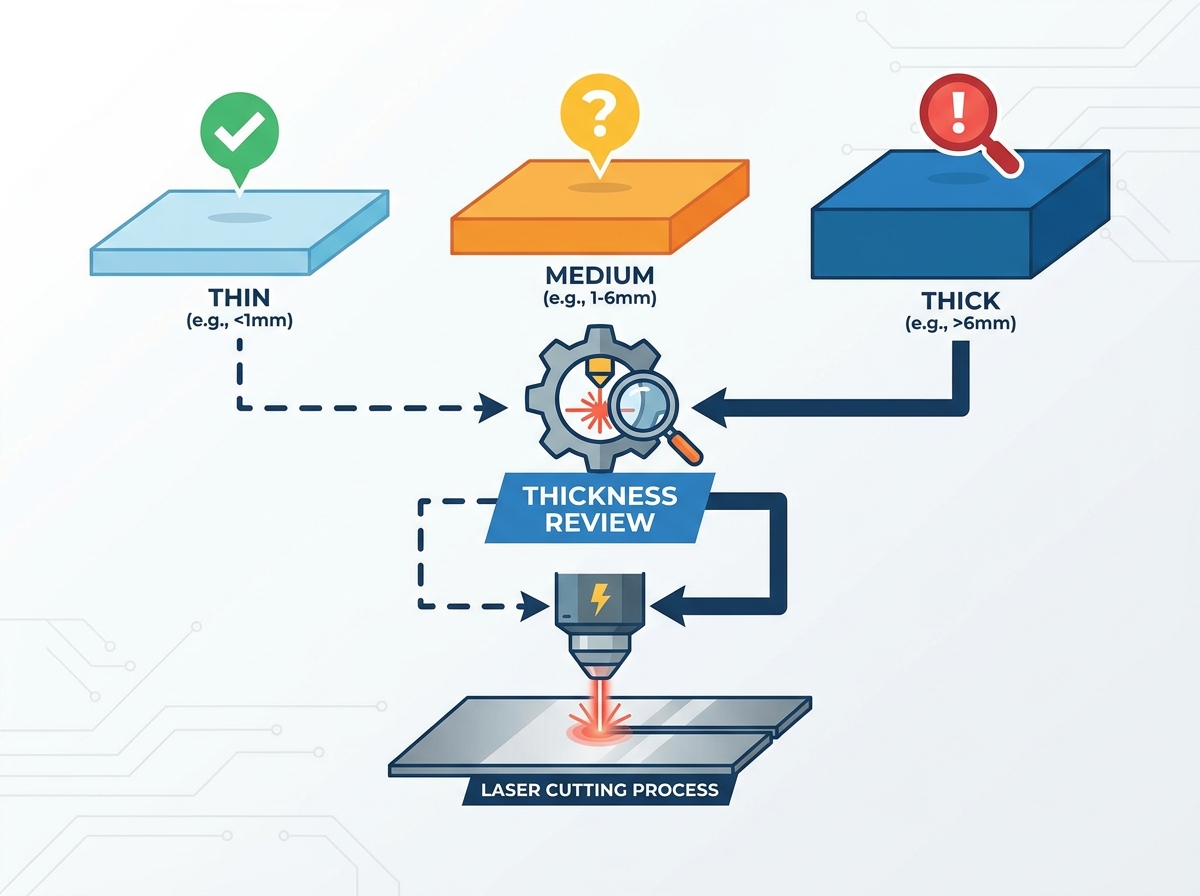
Low-mass sheets absorb heat quickly and have nowhere to dissipate it. This rapid absorption leads to micro-melting and severe warping across the sheet. aluminum laser cutting on ultra-thin gauges demands strict thermal management and precise focal adjustments. Fabricators often apply fiber-laser-compatible protective PE films to prevent surface scratching during handling. These films can affect cutting stability if not properly calibrated, sometimes causing the beam to scatter or creating a messy edge if the film melts unevenly.
Engineering Review Criteria for Ultra-Thin Aluminum:
Check for adequate part spacing in the nest to prevent localized heat buildup.
Implement thermal relief strategies, such as alternating cut sequences across the sheet.
Verify that the protective film is rated for fiber laser processing.
Ensure micro-joints are small enough to break cleanly without bending the thin part.
This range represents the most stable environment for aluminum processing. The material mass balances perfectly with standard laser power outputs, allowing for high-speed cutting with minimal defects. Thermal distortion risks drop significantly because the sheet has enough mass to absorb and dissipate the heat without warping. Standard tolerance checks apply here, and operators rarely need to intervene during the cutting cycle. These thicknesses are generally safe for automated quoting and rapid production runs without extensive manual engineering reviews.
Engineering Review Criteria for the Sweet Spot:
Confirm standard hole-to-thickness ratios (1:1).
Verify standard tolerances (typically ±0.005” to ±0.010”).
Check for standard lead-in and lead-out placements on the toolpath.
Cutting thick plates introduces new physical challenges that require experienced operators. Dross often forms on the bottom edge of the cut as the molten material struggles to clear the deep kerf. Striation marks become highly visible on the cut face, indicating the pulse rate of the laser and the flow dynamics of the assist gas. Kerf width expansion also occurs, requiring adjustments to the cutting path to maintain tight tolerances. The piercing sequence must be carefully managed to prevent cratering on the surface.
Engineering Review Criteria for Thick Plate:
Evaluate the need for secondary deburring or edge-routing operations.
Assess kerf width expansion and adjust cutter compensation in the CAM software.
Implement pulsed piercing sequences to prevent surface blowouts.
Review internal corner radii to prevent heat traps.
Most commercial laser cutters hit their upper limits past half an inch when processing aluminum. Even with high-wattage machines, edge taper increases dramatically with thickness. The cut face loses its perpendicularity, creating a slight V-shape that can interfere with mating parts in an assembly. Engineers must determine if laser cutting remains the best option for the specific part geometry. Waterjet cutting or CNC routing often provide more viable alternatives for maintaining required tolerances and perfectly square edges on massive plates.
Engineering Review Criteria for Maximum Limits:
Measure acceptable edge taper for the final assembly.
Compare laser cutting cycle times against waterjet or routing.
Evaluate the structural impact of a larger Heat-Affected Zone.
Fiber lasers operate at a 1.06 µm wavelength. Aluminum absorbs this wavelength highly efficiently, allowing the beam to penetrate the surface and initiate the melt pool almost instantly. CO2 lasers operate at 10.6 µm, which aluminum reflects heavily. This fundamental difference makes fiber lasers the undisputed industry standard for aluminum sheet fabrication. They provide safe, efficient, and rapid processing without the constant threat of optical damage. Shops running modern fiber equipment can push feed rates significantly higher, reducing cycle times and lowering the overall cost per part.
The choice of assist gas drastically alters the edge quality and the cost of the operation. High-pressure Nitrogen acts as a shielding gas. It prevents oxidation during the cut and delivers a clean, weld-ready edge that requires no secondary cleaning. High-pressure clean dry air (CDA) offers a practical, cost-effective alternative for non-aesthetic mid-range thicknesses. Cutting thicker aluminum plates with Nitrogen requires massive gas volumes, driving up hourly operating costs. Engineers must weigh the benefits of a pristine edge against the high consumption rates of assist gases.
| Assist Gas | Edge Quality | Cutting Speed | Best Application |
|---|---|---|---|
| Nitrogen | Excellent (No oxidation) | Fast | Parts requiring welding or powder coating. |
| Clean Dry Air (CDA) | Good (Slight oxidation) | Very Fast | Internal structural components, cost-sensitive runs. |
| Oxygen | Poor (Heavy oxidation/burnt edge) | Slow | Rarely used for aluminum; causes rough edges. |
A strict rule of thumb governs hole placement on the shop floor. The minimum hole diameter should generally equal the material thickness (a 1:1 ratio). If you try to cut a 0.125" hole in a 0.250" plate, the intense heat required to pierce the material will melt the surrounding area, destroying the hole's geometry. Piercing thick plates requires specific strategies. Pulsed piercing, where the laser fires in short bursts, prevents blowouts better than step piercing in plates over 0.250”. Failing to manage the pierce leads to cratering, ruined parts, and potential damage to the cutting nozzle.
Tolerance capabilities degrade as aluminum thickness increases. Thin sheets easily hold ±0.005” because the laser moves quickly and the kerf remains narrow. Thick plates often drift closer to ±0.020” due to beam divergence and edge taper. Engineers must reference ISO 9013 standards when defining acceptable deviations on their prints. Tight tolerances on thick plates usually require secondary machining operations, such as reaming holes or milling edges, which must be factored into the production timeline.
Different alloys react differently to the laser beam based on their chemical makeup. You cannot treat all aluminum the same when programming the machine.
5052 (Marine Grade): Highly formable and clean-cutting. This is the most laser-friendly alloy, producing smooth edges with minimal dross.
6061 (Structural Grade): Excellent strength but prone to minor dross due to its silicon and magnesium content. It requires slightly slower feed rates to maintain edge quality.
2024 & 7075 (Aerospace Grades): High copper and zinc content makes them extremely sensitive to micro-cracking and HAZ degradation. These alloys require strict thermal monitoring and often mandate post-cut inspections.
Sharp internal corners in thick aluminum act as dangerous heat traps. As the laser slows down to navigate a sharp 90-degree turn, heat builds up rapidly, causing localized melting and blowing out the corner. CAD files require radiused corners to keep the cutting head moving at a consistent speed. Small, thick parts risk tipping into the laser slat bed after they are cut free. Engineers must implement micro-joints or tab systems to keep these laser cut aluminum parts secure within the skeleton during the cutting cycle, ensuring they do not crash the cutting head.
Pushing a laser to its maximum thickness capacity slows down travel speeds significantly. Slower speeds increase heat input, which raises the risk of warping and increases scrap rates. Fabricators must analyze this financial trade-off before accepting a job. Sometimes utilizing a different cutting method, like a waterjet, yields better overall efficiency for thick plates, even if the hourly rate of the machine is higher. You have to look at the total yield, not just the cutting speed.
Failing to review thick aluminum designs leads directly to hidden expenses on the shop floor. Manual deburring consumes massive amounts of labor and slows down the entire shipping schedule. Edge grinding to remove heavy striations adds unnecessary complexity. Re-tapping warped holes or reaming undersized features destroys profit margins. Proper DFM reviews eliminate these post-processing bottlenecks by adjusting the design to fit the machine's actual capabilities.
Prototyping scales differently depending on material thickness. Thin aluminum transitions smoothly from a single prototype to high-volume runs of thousands of parts. The process is stable and repeatable. Thick aluminum requires constant monitoring. High-volume runs of thick plates demand robust QA processes to catch degrading edge quality over time as lenses get dirty or assist gas pressures fluctuate. You cannot simply press start and walk away from a 10mm aluminum job.
Fabrication partners must utilize strict safety protocols when processing reflective materials. Back-reflection sensors are mandatory when cutting highly reflective thick plates, automatically shutting down the beam if it bounces back toward the optics. Specialized optical coatings protect the cutting head components. Operators must monitor beam stability continuously, checking the protective cover glass for spatter and ensuring the nozzle remains perfectly centered to prevent equipment failure.
First-Article Inspection (FAI) steps must be rigorous and documented. Inspectors check for micro-cracking within the HAZ using dye penetrant testing on aerospace grades. They measure burr height tolerances meticulously using optical comparators. Verifying edge squareness on gauges over 0.250” ensures the parts meet structural requirements before the full run begins. If the first part fails these checks, the operator must adjust the focus, gas pressure, or feed rate before continuing.
Aluminum laser cutting delivers exceptional efficiency, but material thicknesses below 0.040” and above 0.250” demand strict engineering oversight. Part viability depends entirely on matching the right laser technology to the specific alloy and thickness. Buyers should partner with fabricators utilizing high-wattage fiber lasers who offer automated DFM feedback and transparently discuss hole-to-thickness limitations.
Next Steps for Engineering Teams:
Submit your CAD files for a technical DFM review prior to finalizing the design.
Request specific feedback on thermal distortion risks based on your chosen material gauge.
Verify the assist gas requirements to ensure the edge quality meets your secondary processing needs.
Confirm the fabricator's maximum thickness capabilities and their QA protocols for edge squareness.
A: While ultra-high-power fiber lasers can cut up to 1 inch (25mm), the practical limit for clean, precision edges in standard manufacturing is typically around 0.500” to 0.750”. Beyond this, edge taper and dross become significant issues.
A: Aluminum possesses high thermal conductivity, which dissipates cutting heat rapidly away from the cut zone. It also features high reflectivity, which resists the initial laser beam coupling, requiring higher power to initiate the cut.
A: Thin aluminum cuts cleanly with Nitrogen, leaving smooth edges. However, thicknesses over 0.250” often develop dross on the bottom edge. This buildup typically requires secondary mechanical deburring to achieve a finished state.
A: Fabricators follow a strict 1:1 rule. The minimum hole diameter should equal the material thickness. This ratio prevents excessive heat buildup and blowouts during the initial piercing sequence.
A: 5052 is highly formable and laser-friendly. 6061 is excellent for structural parts but may exhibit slightly rougher cut edges. Copper-heavy aerospace grades like 2024 and 7075 are prone to micro-cracking and require extreme caution.
A: Nitrogen provides a clean, oxide-free edge ideal for subsequent welding or powder coating. Oxygen, while sometimes used for speed, can leave a burnt, oxidized edge that requires mechanical removal before further processing.


